Paddle construction, explained.

Buyer's guide

Paddle construction, explained.

Seventeen cores, twenty five face materials, four shapes. What each one changes, what it costs, and how to choose without guessing.

17cores and constructions 25face materials 3M+paddles produced a year

Start here

Four things change how a paddle plays.

Two paddles can look identical and play nothing alike. Everything that matters is decided by four choices, and only one of them is visible from the outside.

1 2 3 4

Cutaway of a honeycomb core paddle. Your artwork prints on the face.

  1. The face

    The hitting surface. It sets spin and control, and it is the layer your artwork prints on. Raw carbon grips the ball hardest. Fiberglass flexes more and gives power back for less swing speed.

    Carbon, Kevlar, titanium weave or fiberglass

  2. The core

    The part nobody sees and the part that changes feel the most. It sets weight, sound, and how long the ball stays on the face. Honeycomb is consistent and quiet. Foam is plush and heavier through the ball.

    17 cores, in five families

  3. The shape

    Reach against forgiveness, and you cannot have both. A standard face has the widest sweet spot. An elongated one reaches further and hits harder, with less room for error.

    Standard, hybrid, elongated, wide body

  4. The handle

    Length changes leverage, circumference changes comfort. Standard grips run about 4.0 to 4.25 inches around. Too small or too large causes arm strain over a long session, so it is worth getting right.

    Grip ring and end cap can carry your mark

Inside the paddle

17 cores, in five families.

Honeycomb is the industry standard, consistent and quiet. Thermoformed builds wrap a unibody shell around a foam edge for a bigger sweet spot. Full foam is plush and heavy through the ball. Hybrid foam adds a frame. Shaped cavities engineer the space itself, with a power ring, a diamond lattice or three tuned flex zones.

  • PP Honeycomb paddle construction

    PP Honeycomb

    Polypropylene honeycomb, the industry-standard all-court core.

  • Aramid paddle construction

    Aramid

    Aramid honeycomb for a softer, more controlled feel.

  • Gen 2 paddle construction

    Gen 2

    Thermoformed unibody with foam-injected edge walls.

  • Gen 3 paddle construction

    Gen 3

    Floating-core construction for added power.

  • Gen 4 paddle construction

    Gen 4

    Refined thermoformed power build with a larger sweet spot.

  • Gen 5 paddle construction

    Gen 5

    Our newest-generation thermoformed construction.

  • EPP paddle construction

    EPP

    Full foam core with a plush feel and a quiet hit.

  • Aramid Gen 4 paddle construction

    Aramid Gen 4

    Aramid face technology on a Gen 4 platform.

  • EPP + ETP 03 paddle construction

    EPP + ETP 03

    Hybrid foam core with a reinforced perimeter frame.

  • EPP + ETP 02 paddle construction

    EPP + ETP 02

    Hybrid foam core with a windowed power layout.

  • EPP Wave paddle construction

    EPP Wave

    Wave-channel foam core for controlled flex.

  • Boom paddle construction

    Boom

    Solid full-foam build tuned for maximum pop.

  • CANO EPP paddle construction

    CANO EPP

    Contoured foam core with a crisp response.

  • EPP Long paddle construction

    EPP Long

    Elongated foam build for extra reach and leverage.

  • Power Ring Core paddle construction

    Power Ring Core

    Perimeter power ring for stability and swing weight.

  • Diamond Core paddle construction

    Diamond Core

    Diamond-pattern core for a stiffer, faster face.

  • Tri-Zone Flex paddle construction

    Tri-Zone Flex

    Three tuned flex zones across the face.

Most brands build on one or two of these. Not sure which fits your project? We will recommend one based on feel, budget and quantity.

Talk to our team

The decision

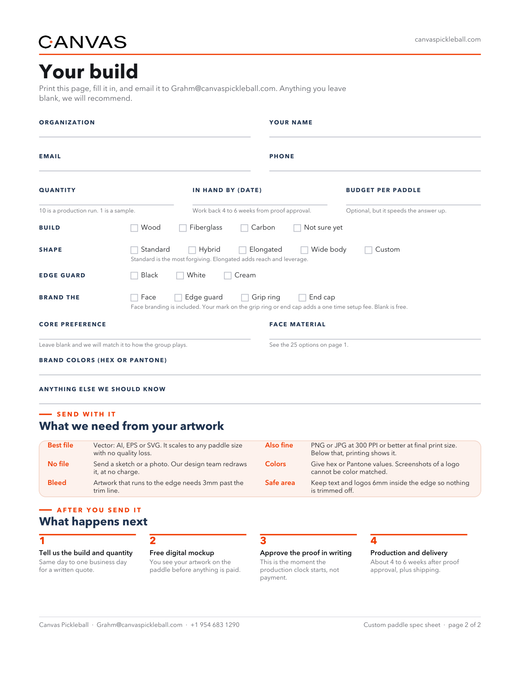
Three builds, three budgets.

Nearly every project comes down to this choice first. Pick the build, then the core and the face inside it. Your artwork on the face is included at every tier.

  • Essential wood

    The value option, and the heaviest.

    Face Hardwood ply
    How it plays Heavy and solid, no flex
    Best for Giveaways, fundraisers, casual play
    Minimum 10 paddles
    At 10 $40 each
    At 100 $23 each
    At 500 $20 each
    See wood paddles
  • Most ordered

    Performance fiberglass

    The middle ground most orders land on.

    Face Woven fiberglass
    How it plays Forgiving, extra pop, softer response
    Best for Clubs, schools, events, mixed ability groups
    Minimum None, order one
    At 10 $55 each
    At 100 $31 each
    At 500 $26 each
    Design a fiberglass paddle
  • Elite carbon fiber

    What competitive players ask for by name.

    Face Raw T300 or T700 carbon
    How it plays Crisp, controlled, highest spin
    Best for Competitive players, pro shops, brand launches
    Minimum None, order one
    At 10 $72 each
    At 100 $42 each
    At 500 $36 each
    Design a carbon paddle

Prices are per individual paddle, in US dollars. Want one first to hold in your hand? A single paddle is $95 in fiberglass and $125 in carbon. There are no design or setup fees at any quantity.

Carbon, and what the numbers mean.

The hitting surface

Carbon, and what the numbers mean.

Raw carbon fiber is the competitive standard, and the T number is the fibre grade rather than a marketing tier. Higher is stronger, not automatically better: the softer grade gives more feedback, which some players prefer.

Whatever the face, it is also your print surface. A weave with visible texture becomes part of the design rather than something to cover up.

  • T700 carbon: higher tensile strength, more durable
  • T300 carbon: slightly softer, more feedback through the hand
  • Textured and treaded finishes add grip for spin, and stay tournament legal
  • Fiberglass flexes more, so it returns power for less swing speed
  • Kevlar and titanium weaves change feel, and double as the graphic
See all 25 surfaces

The full lineup

25 face materials.

Nine carbon weaves, ten Kevlar colorways, four titanium finishes and fiberglass. Almost nobody offers this range, which is why a colored Kevlar weave can be the design rather than something printed on top of it.

  • Fiberglass paddle surface material

    Fiberglass

  • T300/T700 Carbon paddle surface material

    T300/T700 Carbon

  • 3K Carbon paddle surface material

    3K Carbon

  • 12K Carbon paddle surface material

    12K Carbon

  • 18K Carbon paddle surface material

    18K Carbon

  • 3D3K Carbon paddle surface material

    3D3K Carbon

  • 3D18K Carbon paddle surface material

    3D18K Carbon

  • T700 Cross paddle surface material

    T700 Cross

  • I-shaped paddle surface material

    I-shaped

  • 18K Twill Weave paddle surface material

    18K Twill Weave

  • Hexagonal Carbon paddle surface material

    Hexagonal Carbon

  • Brown-black Kevlar paddle surface material

    Brown-black Kevlar

  • Yellow-black Kevlar paddle surface material

    Yellow-black Kevlar

  • Red-grey Kevlar paddle surface material

    Red-grey Kevlar

  • Red-camo Kevlar paddle surface material

    Red-camo Kevlar

  • Black-camo Kevlar paddle surface material

    Black-camo Kevlar

  • Blue-grey Kevlar paddle surface material

    Blue-grey Kevlar

  • Black-green Kevlar paddle surface material

    Black-green Kevlar

  • Red-black Kevlar paddle surface material

    Red-black Kevlar

  • Pure-red Kevlar paddle surface material

    Pure-red Kevlar

  • Pink-black Kevlar paddle surface material

    Pink-black Kevlar

  • Silver Titanium paddle surface material

    Silver Titanium

  • Blue Titanium paddle surface material

    Blue Titanium

  • Gold Titanium paddle surface material

    Gold Titanium

  • Rose-gold Titanium paddle surface material

    Rose-gold Titanium

Every one of these is available on a custom run. Ask about lead time on the less common weaves.

Take it with you

The printable spec sheet.

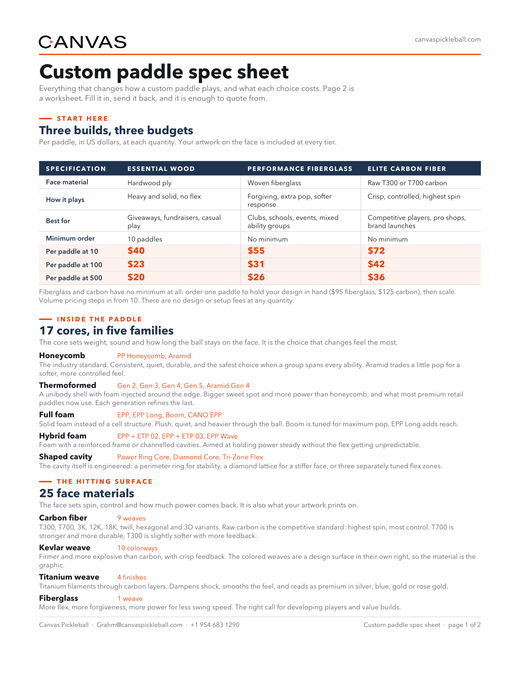
Two pages. Page one is the reference: every build, every core family, every face material, and what each costs at 10, 100 and 500. Page two is a worksheet you fill in and send back, and it is enough for us to quote from.

  • The full price ladder at 10, 100 and 500 paddles
  • 17 cores grouped into five families, in plain English
  • Artwork requirements: file types, resolution, bleed and safe area
  • A one page build worksheet to print and mark up

One field, and the download opens straight away. We will not chase you.

Straight answers

Paddle construction questions

Which paddle core is best?

There is no single best core, only the right one for how a group plays. Polymer honeycomb is the safest choice when abilities are mixed: consistent, quiet and durable. Thermoformed builds give a bigger sweet spot and more power. Full foam feels plush and heavier through the ball. If you are outfitting a club or an event rather than one player, honeycomb or fiberglass almost always ages best.

What is the difference between T700 and T300 carbon?

T700 and T300 are fibre grades. T700 has higher tensile strength and is more durable. T300 is slightly softer and gives more feedback through the hand. Both are raw carbon and both deliver the spin and control that carbon is chosen for, so the choice is feel and budget rather than quality.

Is carbon fiber worth it over fiberglass?

For competitive players, yes: carbon grips the ball harder, which means more spin and more control. For a club program, a school or a corporate event, fiberglass is usually the better buy. It flexes more, so it returns power for less swing speed, which suits developing players, and it costs about a quarter less per paddle.

What is a thermoformed paddle?

A thermoformed paddle is built as a unibody shell with foam injected around the edge walls, rather than a face glued onto a separate core. The result is a stiffer perimeter, a bigger sweet spot and more power. Most premium retail paddles now use some version of it. We build five generations of it, from Gen 2 through Gen 5.

How much does a custom pickleball paddle cost?

At 10 paddles, about $40 each for wood, $55 for fiberglass and $72 for carbon fiber. At 100 that is about $23, $31 and $42. At 500 it is about $20, $26 and $36. There are no design or setup fees at any quantity, and your artwork on the face is included.

What artwork do you need from me?

Vector is ideal: AI, EPS or SVG. A PNG or JPG works if it is 300 PPI or better at final print size. If all you have is a sketch, our design team redraws it at no charge. Send hex or Pantone values for your colors, because a screenshot of a logo cannot be color matched.

How long does a custom paddle order take?

About 4 to 6 weeks after you approve the proof in writing, plus shipping. The clock starts at proof approval rather than at payment, so approving quickly is the single biggest thing you control.

What is the minimum order?

Fiberglass and carbon have no minimum at all. You can order a single paddle to hold your design in hand, $95 in fiberglass and $125 in carbon, then scale from there. Volume pricing starts at 10. Wood has a 10 paddle minimum.

Ready when you are

Now put your artwork on one.

Build it yourself in the designer and see it on a real paddle in a couple of minutes, or tell us what you need and we will come back with a free mockup and pricing.