
Pickleball Paddle Specs by Skill Level: A Builder's Guide
Not another best-paddle list. The specs themselves, thickness, weight, shape, face and grip, mapped to skill levels with named testers' reasoning, the rulebook limits, and the section nobody writes: buying for mixed-level groups.

Most paddle advice arrives as a list of models. This guide is the layer underneath: the specs those models are made of, mapped to skill levels. We build custom paddles across every one of these variables, so this is written from the workbench rather than the review bench, and where a recommendation belongs to a tester or a governing body, it is named and linked.
The short version. Up to about 3.5, choose forgiveness: a 16mm core, midweight, standard or wide shape. From 3.5 to 4.0, start matching specs to your style rather than your level, inside the swingweight window two independent testers both recommend, 112 to 118. Above 4.0, level stops being the variable; style is. And at every level, grip size is the spec most often gotten wrong, and the one a Harvard Health guide connects to the sport's most common injury.
The cheat sheet
| Level | Core | Weight | Shape | Priority |
|---|---|---|---|---|
| New to 3.0 | 16mm | Midweight | Widebody or standard | Sweet spot and control |
| 3.0 to 3.5 | 16mm | Midweight | Standard | Soft game: blocks, resets, drops |
| 3.5 to 4.0 | 16mm or 14mm by style | Midweight, swingweight 112 to 118 | Standard or hybrid | Matching spec to style |
| 4.0 plus | By style | By style, watch swingweight not static weight | Any, elongated earns its trade-offs here | Fine margins: spin, reach, pop |
What the levels actually mean
Core thickness: the clearest level-linked spec
This is the one spec where a named tester draws an explicit line at a skill number. Chris Olson of Pickleball Studio, who has tested hundreds of paddles: "If you are a new player up to about 3.5, I would usually tell you to opt for a thicker paddle." His reasoning is about where developing players actually lose points: the soft game. A thicker core gives up some power but, in his words, improves "your blocks, resets, and drop shots."
Pickleball Effect's buyer's guide describes the trade the same way: 16mm, the most common thickness, "offers better stability, a larger sweet spot, and absorbs pace better than 14mm paddles," while 14mm is "more maneuverable and poppy... though you give up some stability." The mechanics behind that trade, and where 13mm and the in-between thicknesses fit, are in our own 14mm vs 16mm guide.
Weight, and the number that matters more
Published weight bands run roughly: lightweight around 7.2 oz and under, midweight about 7.3 to 8.4 oz, heavy above that, with the exact boundaries varying a tenth of an ounce or two between sources. Midweight is the standard recommendation for developing players, and it is where most paddles live.
Shape: where the experts genuinely disagree
The conventional map, as Pickleheads puts it: elongated paddles, 16.5 inches and up, are "the shape most advanced players use," but "won't suit beginners... as they are narrower and less forgiving with a smaller sweet spot." Standard shapes trade reach for forgiveness.
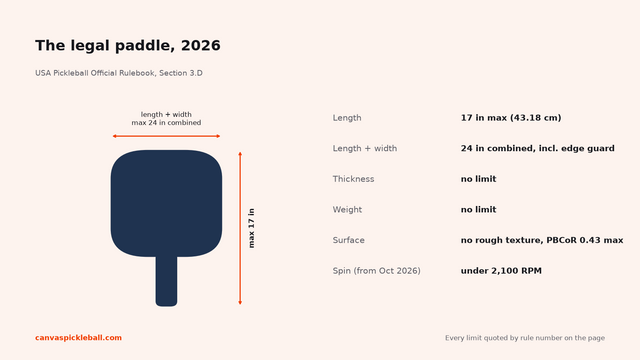
The rulebook bounds all of it: under the current USA Pickleball rules, combined length and width cannot exceed 24 inches and length cannot exceed 17 inches, while thickness and weight are explicitly unrestricted. Every shape on the market is an answer to that same constraint.
Face material: mostly a style choice, honestly
Grip size: the spec everyone skips, and the injury one
Modern grips run roughly 3.75 to 4.25 inches in circumference. The common sizing check is the index-finger test: hold the paddle in your normal grip and slide the index finger of your other hand into the gap between your fingertips and the heel of your palm. A snug fit is right; no room means too small, spare room means too large. When in doubt, size down, because an overgrip can add circumference but nothing can remove it.
Buying for a group of mixed levels
Almost nobody writes this section, and it is the question we get weekly from clubs, resorts and programs: what do you buy when the same paddles serve a 2.5 beginner on Tuesday and a 4.0 league player on Thursday?
Common questions
What paddle thickness should a beginner use?
16mm. Tester guidance is unusually aligned here: thicker cores give a larger sweet spot, more stability and a better soft game, which is where new and intermediate players lose most points. Pickleball Studio's Chris Olson draws the line at about 3.5 before thinner cores are worth considering.
What swingweight should I look for?
112 to 118 for most players, a window Pickleball Studio and Pickleball Effect arrived at independently, with twist weight above 6 for a forgiving sweet spot. Swingweight measures how heavy the paddle feels in motion, which testers consider far more meaningful than the number on a scale.
Do beginners need a carbon fiber paddle?
No. Carbon has become the default face material at every level, but no independent tester maps face material to skill. Thickness, weight and shape change how a paddle plays more than the face does. A well-built fiberglass paddle is a perfectly good first paddle.
What grip size should I use?
Use the index-finger test: with your normal grip, your other hand's index finger should fit snugly between fingertips and palm heel. Grips run about 3.75 to 4.25 inches around; size down when unsure, since overgrips can add size but not remove it. Harvard Health links poor grip sizing to elbow strain.
What specs should a club buy for shared paddles?
One consistent forgiving build across the fleet: 16mm core, midweight, standard or wide shape, mid-size grip. Forgiving specs cost strong players little and help weaker players a lot, and identical paddles keep coaching and rotation simple.
Sources
- USA Pickleball, player skill rating definitions
- USA Pickleball, current official rulebook (paddle dimensions, rule 2.E)
- Pickleball Studio, core thickness and the 3.5 line
- Pickleball Studio, swingweight bands
- Pickleball Effect, paddle buyer's guide
- Pickleheads, how to choose a paddle
- Harvard Health, avoiding the common pickleball elbow injury
- Houston Methodist, Dr. Chia Wu on technique over equipment
Tester quotes come from the linked pages and are attributed to their authors; where the industry repeats a claim no independent tester has verified, we say so. Checked August 2026, and the Updated date above reflects the most recent re-check. If we have your guidance wrong, tell us and we will correct it.
Build your paddle from scratch
Answer three questions and we choose the build, or pick every part yourself.
Build your own paddleKeep reading
-
 Which Pickleball Paddle Is Right for Me? Three Questions That Decide It
-
 Pickleball Paddle Dimensions and Legal Limits: The 2026 Spec Sheet
-
 Do Expensive Pickleball Paddles Actually Make a Difference?
