
Which Pickleball Paddle Is Right for Me? Three Questions That Decide It
How to choose a pickleball paddle by how you play, not by a list of models: three questions on play style, spin and shape, the four shapes explained, and where the USA Pickleball rules draw the lines.

Most paddle advice starts with a list of models. This guide starts with you. Three questions decide most of how a paddle should be built: how you play, how much spin you want, and which shape you like in your hand. Answer those, and the core, face and thickness follow. It is the same three questions our paddle finder asks, written out so you can see the reasoning behind each one.
The short version. If you win points with dinks, drops and resets, look at a wider face and a thicker core. If you win them with drives and put-aways, look at a longer shape. If you are new, start in the middle with a standard shape. Pick your spin texture last, and know where the USA Pickleball surface limit sits before you go past it.
Question 1: how do you play?
Think about the shots that decide your games, not the ones you wish you hit. Almost every player fits one of four descriptions.
- Control and consistency. Your game is at the kitchen line: dinks, drops, blocks and resets. You want the ball to go where you aimed it, even off the center of the face.
- Power. You finish points with drives, counters and put-aways, and you want reach and pace.
- All-court. A bit of everything, and no single shot you would give up the others for.
- New to the game. You want a paddle that is easy to play well with while your strokes settle in.
Paddle makers describe the same trade in the same way. Selkirk puts it in one line: "Longer paddles = more reach and potential power. Wider paddles = larger sweet spot and more forgiveness." On thickness, Selkirk says thinner cores "favor power, while thicker cores, around 16 mm, favor control," and Pickleball Central says thicker paddles "make controlling the ball easier." That gives a starting point for each style.
| How you play | Shape to start from | Thickness to start from |
|---|---|---|
| Control and consistency | Wide Body | 16mm |
| All-court | Hybrid | 14mm or 16mm, by feel |
| Power | Elongated | 14mm or 16mm, by feel |
| New to the game | Standard | 16mm |
Treat this as a starting point, not a rule. Pickleball Central notes that many PPA Tour professionals choose a standard shape for its quick hand speed, so the right answer is the one that feels right in your hand. Weight and grip size matter too, and our paddle specs by skill level guide covers both.
Question 2: how much spin do you want?
A rougher face grips the ball and adds spin. USA Pickleball's own standards say as much: they bar surfaces with "rough texturing" or features "that allow a player to impart excessive spin on the ball." So this is the part of the paddle the rules watch most closely, and it helps to know where the lines are.
On a Canvas build you choose from five spin textures:
- Light and Medium: smoother faces, for players who want a clean, predictable feel.
- Tournament limit: built to the USA Pickleball surface limit.
- Xtreme and Xtreme Max: past that limit, for the most grip on the ball. These are for recreational play only.
If you only ever play at your club or with friends, the choice is yours. If you might enter a sanctioned event, read the tournament section below before you pick.
Question 3: which shape?
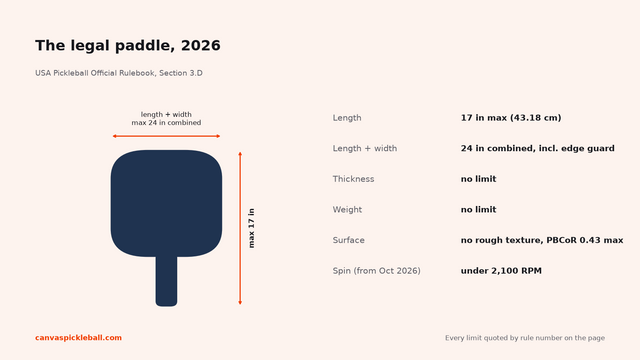
Every shape is an answer to the same rule. USA Pickleball caps a paddle at 17 inches long and 24 inches of length plus width combined, edge guard and butt cap included (Rule 3.D.2). So a paddle can only get longer by getting narrower. Here are the four shapes, explained.
- Wide Body. The width goes into the face. Makers describe a wider face as having a larger sweet spot and more forgiveness, which is why it suits a control game.
- Standard. The classic balance of face width and length. Pickleball Central describes standard shapes as offering a wide sweet spot and being "excellent for beginners."
- Hybrid. A hybrid pickleball paddle is a shape that, in Pickleball Central's words, "fits between the elongated and standard and carries benefits from each." It suits all-court players who do not want to give up either end.
- Elongated. The length goes into reach, with a narrower face. Pickleball Central says elongated paddles "add reach and power potential by moving the sweet spot on the paddle further from your hand."
Elongated vs wide body is the question people ask most, and neither is better for everyone. They are two ends of the same 24-inch trade. If you are unsure, Standard or Hybrid is the safe middle.

Then the details: core, face and thickness
Once you know how you play, how much spin you want and which shape, the remaining choices narrow quickly.
The core. The core sits between the two faces. Honeycomb cores are made of small cells, and full foam cores are one solid piece of foam. Some combine the two, such as honeycomb with foam at the edges, and thermoformed paddles are sealed as one piece. We offer 16 cores across those families. Our foam core vs honeycomb guide explains how each is built, and the thermoformed vs cold-pressed guide covers the build process.
The face. Pickleball Central describes carbon and graphite faces as having "more control or finesse," and fiberglass as storing and releasing more energy. Raw carbon has a natural grit, and patterned carbon shows its weave as part of the design. Kevlar is aramid fiber with the color woven in, and titanium faces are carbon woven with metallic fiber. The carbon vs fiberglass vs wood guide and the Kevlar vs carbon vs titanium guide go deeper.
The thickness. 16mm and 14mm are the two common choices, and USA Pickleball sets no limit on thickness. A thicker core is generally described as steadier, a thinner one as livelier. Our 14mm vs 16mm guide settles the rest.
If you want to see how every piece fits together, the paddle construction guide walks through a paddle layer by layer.
What about tournaments?
This is the part most buying guides skip. Under USA Pickleball's rules, players in sanctioned play "must use an approved paddle" that is listed on the USA Pickleball Approved Paddle List (Rule 18.A), and the paddle must carry a brand and model name and the "USA Pickleball Approved" seal or text (Rule 3.D.1). Meeting the size and surface limits is not enough on its own. The model has to have been tested and listed.
Custom paddles, ours included, are built for recreational play: club nights, leagues, open play, corporate events and gifts. If you want a build certified for sanctioned play, we can take it through USA Pickleball's approval process on request. Approval is decided by USA Pickleball, and our certification cost guide explains what it involves.
Build your paddle with the finder
The Canvas paddle finder asks the three questions above and picks a build for you: core, face, thickness and shape, with a photo of the paddle and its price at every quantity. If you already know what you want, open Advanced + and build your own pickleball paddle from all 16 cores, 25 face surfaces, 14mm or 16mm, four shapes and five spin textures.
Three questions, one paddle. Build your paddle and see your build and its price in under a minute.
Common questions
How do I know which pickleball paddle is right for me?
Start with how you play. Control players tend to start from a wider face and a 16mm core, power players from an elongated shape, and new players from a standard shape. Then choose your spin texture and your face. The Canvas paddle finder asks these questions and picks a build for you.
Is an elongated or wide body pickleball paddle better?
Neither is better for everyone. The rules cap length plus width at 24 inches, so an elongated paddle trades face width for reach and a wide body paddle trades reach for face width. Paddle makers describe wider faces as more forgiving. Standard and Hybrid sit in between.
What is a hybrid pickleball paddle?
A hybrid paddle is a shape between standard and elongated: a little longer than a standard paddle and a little wider than an elongated one. It suits all-court players who want some reach without giving up much face width.
Should I get a 14mm or 16mm pickleball paddle?
Paddle makers generally describe 16mm as steadier and more controlled and 14mm as livelier. If your game is built on control, or you are new, 16mm is the usual starting point. USA Pickleball sets no limit on thickness.
Can I build my own pickleball paddle?
Yes. The Canvas paddle finder lets you choose the core, face, thickness, shape and spin texture yourself and print your own design on both faces. Custom paddles are for recreational play unless the model is certified and listed by USA Pickleball.
Sources
- USA Pickleball, 2026 Official Rulebook (Rules 3.D.1, 3.D.2, 3.D.5 and 18.A)
- USA Pickleball, Equipment Standards Manual, revision 3.0, January 2025 (surface roughness and friction limits, section 2.E.2)
- USA Pickleball, Spin Rate Test update and implementation timeline
- USA Pickleball, Approved Paddle List
- Selkirk, how to choose your pickleball paddle
- Pickleball Central, paddle buying guide
Build your paddle
Answer three questions and see your build and its price at every quantity, or choose every core, face and shape yourself. Your design printed on both faces.
Build your own paddleKeep reading
-
 Pickleball Paddle Dimensions and Legal Limits: The 2026 Spec Sheet
-
 Pickleball Paddle Specs by Skill Level: A Builder's Guide
-
 Do Expensive Pickleball Paddles Actually Make a Difference?
