
Kevlar vs Carbon Fiber vs Titanium Paddle Faces: What Each One Actually Does
Three face materials, measured. Here is what Kevlar, carbon fiber and titanium each do to feel, spin and power, and what the lab data says about how long texture lasts.

Most paddle marketing treats the face as a sticker. It is not. The face and its texture decide how much spin you can generate and how the ball comes off on a reset. Change the face and you have a different paddle, even if the core and shape are identical.
We build custom paddles across all three of these face materials, so this is written from the build side rather than from a review bench. Here is what each one actually does.
The short answer. Carbon fiber is the most common face: crisp, controlled, and it takes a raw texture well. Kevlar gives a little more pop than carbon in the lab data. Titanium is not a face on its own; it is a reinforcement woven into a composite face. How long texture lasts depends on the texture and how much you play.
What the face is actually doing
When the ball hits the paddle, two separate things happen and different materials govern each one.
The first is friction. Spin comes from the ball gripping the surface and rolling across it rather than sliding. That is a function of surface texture and the coefficient of friction, which is why a slick, glossy paddle produces almost no spin regardless of what it is made from.
The second is dwell time. This is how long the ball stays in contact with the face before it leaves. A stiffer face feels crisper; a face with more give holds the ball fractionally longer. Crisp is not the same as powerful: in the lab data, carbon is the least powerful of the three composite faces.
Every difference below comes back to those two things. For how the face interacts with what sits behind it, see our paddle construction guide, which breaks down all 25 face materials and 16 cores we build with.

Carbon fiber: the default, and it deserves to be
Carbon fiber is the most common performance face for good reason. It is stiff for its weight and it takes texture well. And it is available in a wide range of grades and weave patterns, so a manufacturer can tune it.
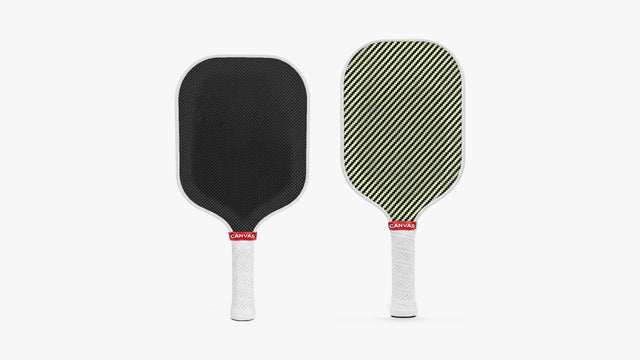
The important distinction is between raw carbon and painted carbon. Raw carbon leaves the resin surface exposed, usually textured during layup by a peel ply that presses a regular pattern into the surface as it cures. That texture is part of the material, not a coating. Painted or grit-sprayed faces add friction with an applied layer, which works well initially and wears faster.
Every textured face wears with use. How fast depends on the texture and how much you play.
Carbon grades matter too, and they are widely misdescribed. We cover that separately in T700 vs T300 and why raw carbon grips the ball.

Kevlar: a little more pop, a little more stability
Kevlar is an aramid fiber, the same family used in protective equipment. In a paddle face it behaves very differently from carbon.
Players often report Kevlar faces holding their bite a long time. Lab durability ratings do not show a difference from carbon, so treat that as a player report, not a measured result.
The face feels softer on touch shots and firms up under a hard swing, and players with elbow or shoulder sensitivity often choose Kevlar for comfort.
Measured, Kevlar returns slightly more energy than carbon, not less. In John Kew's database, Kevlar paddles scored above carbon in the core types with the most Kevlar paddles tested, and they resisted twisting slightly better in most comparisons. The differences are small, and the core matters more.
Worth knowing: a lot of "Kevlar" paddles on the market are Kevlar and carbon blends, not pure aramid faces. A blend is a legitimate design choice and often the smarter one, but it is a different product. If durability of texture is why you are buying, ask what the actual layup is.
Titanium: a reinforcement, not a face
This is the one that gets oversold. No paddle has a face made of titanium. It would be too heavy and far too expensive.
What actually happens is that titanium is introduced into a composite face, either as filaments woven through the carbon or as a titanium compound worked into the outer layer. Manufacturers add it for abrasion resistance and to stiffen the face. There is too little lab data to measure what it changes.
Some builds also use titanium compounds to create micro-texture in the surface for grip. Where that is done well it gives a durable bite that does not depend on a sprayed coating.
Titanium is a genuine engineering choice with real benefits. It is not a magic power material, and any claim that it transforms a paddle should be treated the same way you would treat any other marketing line.
Side by side
| Carbon fiber | Kevlar (aramid) | Titanium reinforced | |
|---|---|---|---|
| Feel | Crisp, high feedback | Soft on touch, firm under load | Not enough lab data |
| Power | Lower | Slightly higher | Not enough lab data |
| Spin | Set by texture | Set by texture | Set by texture |
| Texture life | Depends on texture | Depends on texture | Depends on texture |
| Twist resistance | Baseline | Slightly higher | Not enough lab data |
| Relative cost | Moderate | Higher | Higher |
| Best for | All-round, crisp feel | A little more pop, arm comfort | A metallic finish |
What the rules actually allow
Face material is not a free-for-all. USA Pickleball regulates surface properties directly, and the standards have tightened noticeably.
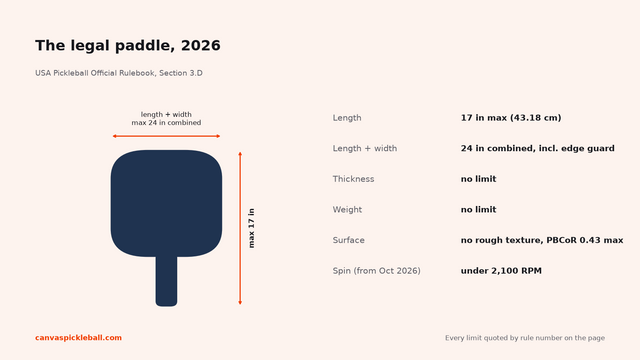
Surface texture is measured two ways, and most articles conflate them. Until 1 October 2026 the limits are 30 micrometers average peak height and 40 micrometers highest peak, with a maximum coefficient of kinetic friction of 0.1875. From 1 October, those become a measurement of record and a spin test becomes the pass line for newly submitted paddles.
Power is capped separately through the Paddle-Ball Coefficient of Restitution test, which measures the trampoline effect. That limit was 0.44 from 1 November 2024 and tightened to 0.43 from 1 November 2025. Those numbers come from USA Pickleball's own PBCoR test documentation rather than secondhand, and they matter because a paddle designed against the older ceiling is not automatically compliant now.
From 1 October 2026, USA Pickleball adds a direct Spin Rate Test. Paddles submitted from that date must measure 2,100 RPM or less on USA Pickleball's spin test, which uses a dual-camera system. Paddles already approved are held to the standards in effect when they were certified.
The practical consequence: if the paddles you are ordering need to be legal for sanctioned play, the face specification and the certification date both matter. This is worth raising early rather than after production.
How to choose
Pick carbon fiber if
You value crisp feedback and control. This is the right default for most orders.
Pick Kevlar or a Kevlar blend if
You want a little more pop than carbon with the same crisp character, or arm comfort matters to you.
Pick a titanium reinforced face if
You want its metallic finish, or the paddles will live a rough life and you want the abrasion resistance manufacturers add it for.
If you are ordering custom
Most custom paddle suppliers print a logo onto whatever blank they happen to stock, which means the face material is whatever they bought. That is a fine way to make event giveaways and a poor way to make a paddle someone plays with.
Face material should be a decision you make, alongside core, thickness, shape and edge guard. We build across carbon in multiple grades, Kevlar and Kevlar blends, titanium reinforced composites and fiberglass, and the right answer genuinely depends on who is going to hold the paddle. A corporate gift and a club league paddle are not the same brief.
If you want to talk through a build rather than pick from a menu, that is a conversation we are happy to have. You can also start from a design and work backwards in the paddle designer.
Common questions
Is Kevlar better than carbon fiber for pickleball?
Neither is better outright. Measured, Kevlar returns a little more energy than carbon; carbon feels crisper. Choose on feel.
Do titanium pickleball paddles exist?
Not as solid titanium. Titanium is added to a composite face as filaments or as a compound in the outer layer, to improve abrasion resistance and torsional stiffness. Any paddle described as being made of titanium is describing a reinforcement, not the material of the face.
How long does paddle texture last?
It depends on the texture and how much you play. We have not found lab data that separates faces by texture life, so be wary of any month figure.
Can you add texture to a paddle to get spin back?
No, and attempting it makes the paddle illegal for sanctioned play. Grip is tested against fixed limits (surface roughness and friction until 1 October 2026, a spin test after), and altering the face after certification voids approval. When the texture is gone, the paddle needs replacing.
Does face material affect whether a paddle is USAP approved?
Indirectly. Approval tests the grip (a spin test from 1 October 2026) and the trampoline effect, both of which the face influences. The material itself is not banned or approved, the finished paddle's measured behavior is.
If the paddles need to be legal for sanctioned play, the face specification and the certification date both matter. See what paddle certification actually costs.
Build your paddle from scratch
Pick your face: carbon, Kevlar or titanium. Then the core, shape and thickness.
Build your own paddleKeep reading
-
 Which Pickleball Paddle Is Right for Me? Three Questions That Decide It
-
 Pickleball Paddle Dimensions and Legal Limits: The 2026 Spec Sheet
-
 Pickleball Paddle Specs by Skill Level: A Builder's Guide
