
What Pickleball Paddle Certification Actually Costs in 2026
Three bodies now certify pickleball paddles and they charge wildly different amounts. Here is what each one costs in 2026, what the tests actually measure, and which one you genuinely need.

If you are launching a paddle brand, certification is the line item that catches everyone out. It is not one fee. There are now three separate organisations testing paddles, their prices differ by two orders of magnitude, and the biggest of them cut its headline fee in half for 2026.
We build custom paddles, so we deal with this from the manufacturing side. What follows is every current figure we can verify, where it came from, and what it adds up to in practice.
The short answer. For 2026: UPA-A charges $10,000 per brand annually plus $3,000 per paddle model, down from $20,000 in 2025. USA Pickleball is reported at roughly $4,500 per model, though it does not publish its fees publicly. IPMA charges $500 CAD a year plus $200 CAD per paddle. Which you need depends entirely on where the paddle will be played.
Why there are three bodies, not one
Until recently this was simple. USA Pickleball, the sport's non-profit national governing body, ran equipment certification and that was that.
Then the professional tours consolidated. The United Pickleball Association of America, or UPA-A, now governs equipment for professional play at PPA and MLP events. It is a separate certification with separate testing and separate money.
Third, and newest, the International Pickleball Manufacturers Association was established in 2024 specifically because the other two had priced smaller manufacturers out. It exists to give independent makers a credible standard they can actually afford.
So the question is not "is my paddle certified." It is "certified by whom, and for which competition."
UPA-A: the professional standard, and the one that changed
UPA-A certification is mandatory for professional competition at PPA and MLP events. A paddle must carry the UPA-A stamp and its model number, and appear on the UPA-A Approved Paddle List.
The 2026 fee structure, taken from UPA-A's own certification page:
| Item | 2026 fee | Detail |
|---|---|---|
| Annual brand fee | $10,000 | Per brand, prorated for new entrants |
| Paddle certification | $3,000 | Valid 24 months, 8 week turnaround |
| Expedited | $2,500 | 4 week turnaround |
| Super expedited | $7,500 | 2 week turnaround |
| Resubmission after a failure | $2,000 | Per failed paddle |
These numbers are new. For 2025 the annual fee was $20,000, with $5,000 per model and $1,000 per variation. UPA-A halved the annual fee and restructured the per-paddle cost for 2026, and is moving from an LLC under the UPA umbrella to an independent 501(c)(6) not-for-profit.
"I think that it's important that we are independent. We are happy to move towards that."
Jason Aspes, President, UPA-A, on the move to not-for-profit status
Watch the arithmetic, not the headline. The annual fee halved, but certification is per model and lasts 24 months. A brand with a five paddle line pays $10,000 plus five times $3,000, so $25,000 in year one before a single paddle is sold. Reporting on the 2026 pricing puts a multi-model brand at $50,000 or more annually.
USA Pickleball: the amateur and sanctioned standard
USA Pickleball certification is what governs sanctioned amateur tournament play, which is where the overwhelming majority of competitive pickleball actually happens. For most brands this, not UPA-A, is the certification that matters commercially.
Here is the honest part: USA Pickleball does not publish its certification fees publicly. The manufacturer section of its equipment site sits behind a brand account login. Every figure in circulation comes from manufacturers who have been through the process rather than from the governing body.
The figures manufacturers consistently report are approximately $4,500 per paddle model, with 8 paddles submitted for testing, around $350 to submit a similar paddle, and roughly $550 to resubmit one that fails. Treat those as well-attested but unofficial, and confirm directly before committing budget.
IPMA: the independent maker's route
The International Pickleball Manufacturers Association was formed in 2024 to serve small and medium manufacturers. Its pricing is a different universe:
| Item | Fee |
|---|---|
| Annual membership | $500 CAD |
| Paddle testing | $200 CAD per paddle |
| Annual licensing and directory listing | $200 CAD per paddle |
The trade-off is recognition. IPMA certification demonstrates that a paddle meets recognised performance and safety standards. It does not make a paddle legal for USA Pickleball sanctioned play or for professional events. For a brand selling to clubs, corporates, resorts and recreational players, that may be entirely sufficient. For a brand chasing tournament players, it is not.
Side by side
| USA Pickleball | UPA-A | IPMA | |
|---|---|---|---|
| Governs | Sanctioned amateur play | Professional PPA and MLP | Independent standard |
| Annual fee | Not published | $10,000 per brand | $500 CAD |
| Per model | ~$4,500 reported | $3,000 | $200 CAD |
| Samples required | 8 paddles reported | Per UPA-A protocol | Per IPMA protocol |
| Validity | Ongoing, subject to standards | 24 months | Annual licensing |
| Turnaround | Varies | 8 weeks, 4 or 2 expedited | Varies |
| Fees public? | No | Yes | Yes |

What the tests actually measure
Certification is not a formality. Paddles fail, and the standards have tightened sharply.
Power. The Paddle-Ball Coefficient of Restitution test measures the trampoline effect, meaning how much the face flexes and springs back. The limit was 0.44 from 1 November 2024 and tightened to 0.43 from 1 November 2025. Those figures come from USA Pickleball's own PBCoR testing document. A paddle designed against the older ceiling is not automatically compliant now.
Surface texture. Two separate measurements that most write-ups collapse into one: 30 micrometres average peak height and 40 micrometres highest peak, with a maximum coefficient of kinetic friction of 0.1875.
Spin. From 1 October 2026, newly certified paddles must also pass a direct Spin Rate Test at under 2,100 RPM. The protocol clamps the paddle, fires a ball at 40 mph into a 30 degree face angle, and measures outgoing spin with a dual-camera system running around 1,500 frames per second.
If you want the engineering behind those numbers, our guide to carbon grades and surface texture and the paddle construction guide go deeper.
The fight the industry is having about this
Certification pricing is genuinely contested, and a guide that pretended otherwise would be doing you a disservice.
When UPA-A announced the original $20,000 annual fee for 2025, the reaction from manufacturers was hostile, including from Selkirk, one of the largest brands in the sport. The concern was straightforward: fees at that level consolidate the market among incumbents who can absorb them, and squeeze out the smaller brands that give players choice.
Nick Bićanić, CEO of paddle brand Reload, has been the most outspoken critic.
"It's the subterfuge, protectionism, manipulations that I can't abide by. It's not about fairness. It's about control. I don't know of a single pickleball paddle manufacturer that actually likes the UPA."
Nick Bićanić, CEO, Reload
UPA-A's position is that testing protects competitive integrity, and the 2026 fee reduction plus the move to not-for-profit status is a direct response to that pressure. Both things can be true: rigorous testing is genuinely necessary, and the cost of it genuinely shapes who gets to compete.
So which certification do you actually need
You need UPA-A if
Your paddles will be used in professional PPA or MLP competition. If that is not your market, this is a five-figure answer to a question nobody asked you.
You need USA Pickleball if
Your buyers play in sanctioned amateur tournaments. Clubs, leagues and competitive players will ask, and "not approved" ends the conversation. For most serious brands this is the one that matters.
IPMA is enough if
You are selling to corporates, resorts, clubs running social play, event organisers and recreational players. That is a large market, and it does not require a paddle to be tournament legal.
You may need none of them if
The paddles are gifts, event giveaways, welcome kits or branded merchandise. Nobody is taking a corporate gifting paddle to a sanctioned tournament. Paying to certify one is money set on fire.
The mistake we see most. A brand budgets for certification it does not need, or discovers late that it needs one it did not budget for. Decide where the paddle gets played before you decide anything else, because that single answer sets the entire cost structure.
What this means if you are starting a brand
Certification is one line in a bigger budget we have priced line by line, and it is the one most likely to blow up a plan. A brand aiming at tournament players should assume mid five figures before the first sale. A brand aiming at clubs and corporates can start for a fraction of that.
That decision also shapes the product. A paddle built to sit comfortably inside the PBCoR ceiling is a different specification from one built purely for feel, and that has to be settled at the design stage rather than after a failed test and a resubmission fee.
This is the sort of thing worth talking through before you commit to tooling. We do that on the phone, without charging for it, on the private label side of what we do.
Common questions
How much does it cost to get a pickleball paddle USAPA approved?
Manufacturers consistently report approximately $4,500 per paddle model with 8 paddles submitted, around $350 for a similar model and roughly $550 to resubmit after a failure. USA Pickleball does not publish its fees publicly, so confirm directly before budgeting.
How much is UPA-A certification in 2026?
$10,000 per brand annually plus $3,000 per paddle model, which is valid for 24 months on an 8 week turnaround. Expedited testing is $2,500 for 4 weeks and $7,500 for 2 weeks, and a resubmission after a failure is $2,000. The annual fee was halved from $20,000 in 2025.
Do I need both USA Pickleball and UPA-A certification?
Only if your paddles will be used in both sanctioned amateur and professional competition. UPA-A governs professional PPA and MLP play, USA Pickleball governs sanctioned amateur play. Most brands need one, not both.
Is there a cheaper way to certify a pickleball paddle?
Yes. The International Pickleball Manufacturers Association charges $500 CAD annual membership, $200 CAD per paddle for testing and $200 CAD annual licensing per paddle. It demonstrates the paddle meets recognised standards but does not make it legal for USA Pickleball sanctioned or professional play.
Do custom or branded paddles need to be certified?
Not usually. Paddles made as corporate gifts, event giveaways, welcome kits or club merchandise are not being taken into sanctioned tournaments, so certification adds cost without adding value. Certification matters when your buyers compete.
Sources
- UPA-A, 2026 Certification fees and requirements
- USA Pickleball, PBCoR test protocol and thresholds
- The Dink, UPA-A reduced fees and not-for-profit transition
- The Dink, the original $20,000 announcement and manufacturer reaction
- Speak Pickleball, Reload CEO Nick Bicanic on UPA-A
- International Pickleball Manufacturers Association
Figures verified at the time of writing. Certification pricing in this sport has changed twice in eighteen months, so check the governing bodies directly, or our certification fee tracker which we keep current, before you budget. If you spot something out of date here, tell us and we will correct it.
Keep reading
-
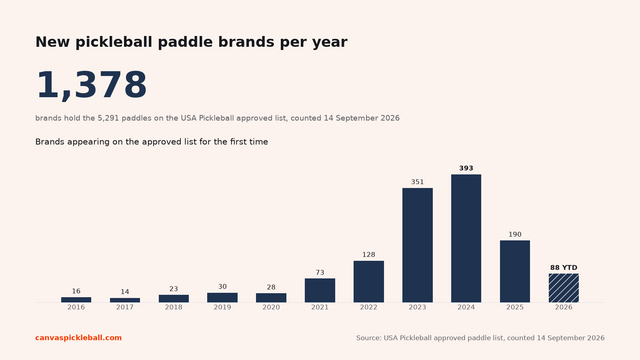 How Many Pickleball Paddle Brands Are There? We Counted Them
-
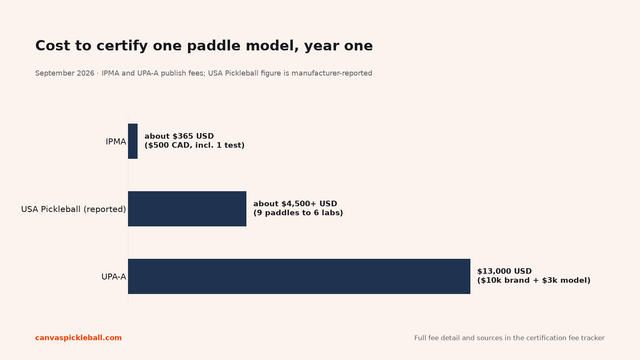 IPMA Pickleball Paddle Certification: Fees, Process and Who It Fits
-
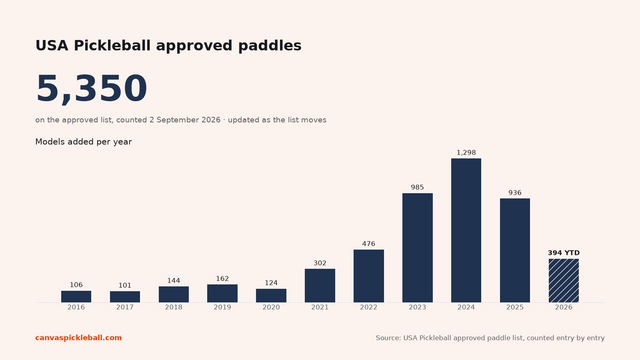 How Many USA Pickleball Approved Paddles Are There? The Count
