
How Much It Actually Costs to Start a Pickleball Paddle Brand
Factory listings say a custom paddle costs $12. Founders say the market has 5,334 approved paddles already. Both are true. The full bill for starting a paddle brand in 2026, line by line, with sources.

Ask a factory what it costs to start a paddle brand and you will hear a number like twelve dollars a paddle. Ask a founder who has done it and you will hear a much bigger one. Both are telling the truth. The factory is quoting one line of a bill that has about ten lines on it.
We build custom paddles and gear for other people's brands, so we see these budgets from the manufacturing side. What follows is every line item we can verify, where each figure comes from, and what three realistic versions of the bill add up to.
The short answer. Testing the idea with a small white-label run costs roughly $2,000. A serious direct-to-consumer launch, with a certified paddle and real inventory, runs roughly $25,000 to $35,000. A brand chasing tournament players with multiple certified models should budget $60,000 or more in year one. The spread comes from three decisions: how many paddles, certified by whom, and how loudly you need to be heard.

What a paddle costs at the factory gate
The raw numbers are public. On Made-in-China, custom-logo carbon fiber paddles list at $11.77 to $21.80 a paddle with minimums of 100 to 200 pieces. Alibaba listings for T700 carbon paddles run around $23.50 at small quantities, with samples about $45. A mid-range thermoformed build from a factory's own published tiers sits at $25 to $38 at the factory gate.
Those paddles retail, with a brand on them, at $99 to $250. Vatic Pro's PRISM sells for $99.99, 11SIX24's Power 1 for $99, and JOOLA's Ben Johns signature paddle for $249.95. That gap is why everyone thinks this is easy money, and it is the most misleading arithmetic in the sport.
Where you build is its own argument. Carve Sports founder Nick Aho makes his $129 paddles in China deliberately: "We believe we can produce advanced equipment that compares directly to current top-of-the-line models for a fraction of the cost." Paddletek president Curtis Smith takes the other side: "We make our product in the USA because the quality of materials are better, we can better control the quality, and we can maximize the performance of our paddles." By The Dink's count, only 12 brands manufacture paddles in America. For everyone else, the next section is part of the unit cost.
The import bill nobody puts on Instagram
Pickleball paddles enter the US under HTS 9506.99.60, per CBP's own classification rulings, at a base duty of 4 percent. What stacks on top depends on origin. As of August 2026:
| Origin | Base duty | Section 301 (2020) | Section 301 forced labor (Jul 2026) | Total |
|---|---|---|---|---|
| China | 4% | 7.5% | 12.5% | 24% |
| Vietnam | 4% | none | 12.5% | 16.5% |
| Thailand | 4% | none | 12.5% | 16.5% |
Two more changes matter for small runs. The $800 de minimis exemption, which once let samples and tiny orders in duty free, ended for Chinese goods in May 2025 and for every country that August. It has stayed dead through the court fights since. Every commercial shipment now pays duty and clears customs properly, which means entry costs: a single-entry customs bond and broker filing typically add $150 to $500 per shipment at first-timer volumes.
Then freight. August 2026 ocean spot rates run high, with Drewry's index putting Shanghai to Los Angeles around $6,800 per 40-foot container. A first production run does not fill a container; it ships as loose freight, where handling fees dominate and 1 to 2 cubic metres lands all-in around $250 to $600. Air freight for a sample box runs a few dollars per kilogram plus courier handling.
The landed-cost arithmetic, worked. 500 paddles at $25 from a Chinese factory is $12,500 at the gate. Duty at 24 percent adds $3,000. Two cubic metres of ocean freight adds about $600, bond and brokerage about $400. The real number is roughly $16,500, or $33 a paddle. If your margin model was built on $25, it just quietly lost a quarter of itself. Run your own quote through our landed cost calculator to see this arithmetic on your numbers.
Certification: the decision that sets your ceiling
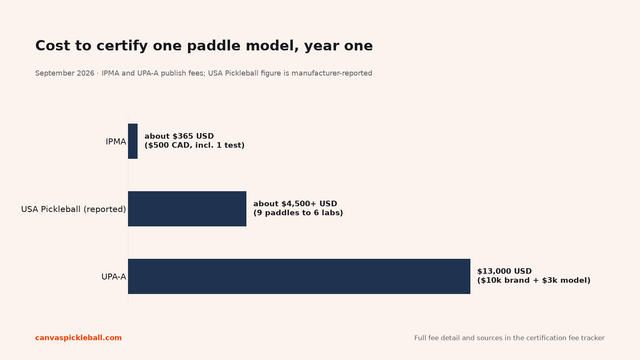
Certification is the line that varies by two orders of magnitude depending on who your customer is, and we wrote a full guide to what paddle certification costs. The 2026 shape of it:
| Route | Cost | Who needs it |
|---|---|---|
| USA Pickleball | ~$4,500 per model, 8 paddles submitted (manufacturer reported) | Brands selling to sanctioned amateur tournament players |
| UPA-A | $10,000 per brand annually plus $3,000 per model | Brands whose paddles will appear in professional PPA and MLP play |
| IPMA | $500 CAD a year plus $200 CAD per paddle | Independent makers selling to clubs, corporates and recreational players |
| None | $0 | Gifts, giveaways, merchandise and event gear |
Small makers publish their own experience of this. Brick House Paddles, an independent brand, lists the USA Pickleball fee at $4,500 per model with eight paddles required for submission. And it is not just money, it is time. Mitchell Chapman of paddle brand PCKL's advice to new brands is about the calendar: "Leave some time for it; that's always the thing. People want to start selling it now."
The strategic point from the certification guide bears repeating here: decide where your paddle will be played before you spend anything else, because that single answer swings your year-one budget by tens of thousands of dollars.
The boring paperwork, priced
None of these numbers will hurt you. Skipping them can.
| Item | Cost | Detail |
|---|---|---|
| LLC formation | $125 in Florida | $100 articles of organization plus $25 registered agent designation. Then $138.75 a year for the annual report. Other states are broadly similar. |
| EIN | Free | Direct from the IRS. Anyone charging you for one is reselling a free form. |
| Federal trademark | $350 per class | USPTO base application fee since January 2025, with surcharges of $100 to $200 per class if your filing needs custom descriptions. Optional but cheap insurance on the name you are about to promote. |
| UPC barcodes | $30 per product, or $250 | A single GS1 US GTIN is $30, one time. A 10-product company prefix is $250 plus $50 a year. Needed the moment a retailer stocks you. |
| Product liability insurance | ~$600 a year | Insureon's median for small businesses at $1M/$2M limits is about $50 a month. You are selling an object people swing at each other. Carry it. |
| Website | ~$470 a year | Shopify's basic plan at $39 a month. A template and your own photography are fine to start; a custom build is not what your first customers are buying. |
Marketing: the line that eats whatever is left
The founders who made it through say the same thing from both directions. 11SIX24 founder David Groechel: "With so many brands and paddles on the market, it's getting tougher and tougher to stand out, so quality and durability are huge for us." Garrett Gosselin, who started CRBN after losing his sommelier job in the pandemic, describes the low barrier honestly: "My mom lent me a little bit of money, a friend loaned me a little bit of money, and I just threw it up and crossed my fingers." His first run sold out in a week, and his conclusion after four years in the market is the same as Groechel's: "You have to stand out, and so we've had to get better and better."
So the marketing line is not optional and it is not small. For a real launch, plan on spending as much as your first inventory order: creative, a launch event or demo days, seeding paddles to local coaches and club pros, and paid social you measure honestly. A brand that budgets $25,000 for paddles and $0 for telling anyone about them has bought inventory, not a business.
Three budgets, worked
Test the idea: about $2,000
| Line | Cost |
|---|---|
| Samples, 2 rounds | $200 |
| 25 white-label paddles at ~$25 | $650 |
| Air freight and duties on a small box | $400 |
| LLC, insurance start, simple site | $750 |
| Total | ~$2,000 |
A real direct-to-consumer launch: $25,000 to $35,000
| Line | Cost |
|---|---|
| 500 paddles, mid-tier thermoformed, with covers and packaging | $12,500 |
| Ocean freight, duties and brokerage | $4,000 |
| USA Pickleball certification, one model | $4,500 |
| Company, trademark, barcodes, insurance, site | $2,000 |
| Launch marketing | $6,000 to $12,000 |
| Total | ~$29,000 to $35,000 |
A tournament-grade brand: $60,000 plus
| Line | Cost |
|---|---|
| 1,000 paddles across two models | $25,000 |
| Freight, duties and brokerage | $7,500 |
| USA Pickleball, two models | $9,000 |
| UPA-A brand fee plus two models | $16,000 |
| Company, trademark, insurance, site | $2,500 |
| Marketing and sponsored players | $10,000 plus |
| Total | ~$70,000 |
Where the money actually goes wrong
Certifying a paddle nobody will tournament with. The most common waste we see. Corporate, club and event paddles do not need approval, and $4,500 spent proving otherwise is $4,500 not spent on customers.
Ordering 500 before selling 25. The minimum on the purchase order is not the minimum the market gave you. A small run answers the only question that matters, which is whether anyone who is not your friend will pay for this.
Budgeting the factory price as the cost. The lines between the factory gate and your door add roughly a third to the quoted unit price at container-share volume, and more than half on a small air-freighted run. If your margin only works at the factory price, it does not work.
Where Canvas fits, and where we don't
If you are further along and deciding what the paddle itself should be, the construction guide covers cores, faces and thicknesses, and our custom paddle pricing guide covers what finished paddles cost per unit.
Common questions
How much does it cost to start a pickleball paddle brand?
Roughly $2,000 to test the idea with a small white-label run, $25,000 to $35,000 for a real direct-to-consumer launch with a USA Pickleball certified model and 500 units of inventory, and $60,000 or more in year one for a brand with multiple certified models aimed at tournament players.
How much does it cost to manufacture a pickleball paddle?
Published factory listings for custom-logo carbon fiber paddles run about $12 to $38 at the factory gate depending on construction, with minimums of 100 to 300 pieces and samples around $45 to $100. Freight, tariffs and brokerage add substantially to that before the paddle reaches you, especially at small volume.
Do I need USA Pickleball approval to sell paddles?
No. Approval matters only if your customers play sanctioned tournaments. Corporate gifts, club paddles, event giveaways and recreational gear need no certification at all, which removes roughly $4,500 per model from the budget.
What is the minimum order for starting a paddle line?
Factories typically quote 100 to 300 pieces for custom paddles. Working through a domestic partner can bring that down sharply; our own paddle volume pricing starts at 10 units and most products can be sampled as a single unit first.
Can I start a pickleball paddle brand with $5,000?
You can test one. $5,000 covers a small white-label run, an LLC, insurance, a simple store and a modest launch push. What it does not cover is certification or meaningful inventory, so treat it as the budget for finding out whether your brand sells, not for scaling it.
Sources
- USA Pickleball Approved Paddle List, 5,334 paddles at the time of writing
- SFIA 2026 Pickleball Single Sport Report, 24.3M US players in 2025
- Business Insider, CRBN founder Garrett Gosselin on starting the brand
- The Kitchen, 11SIX24 founder David Groechel on standing out
- Pickleball Effect, Groechel on self-funding
- Pickleball Studio, on white-label paddles sharing a factory
- The Dink, roughly 250 new approved models in 2026 year to date
- Brick House Paddles, a small maker's certification costs
- Pickleball Union, PCKL on certification lead time
- Made-in-China, custom logo paddle listings and minimums
- PickleTip, an independent startup cost model
- CBP ruling N347450, paddle classification and base duty
- Federal Register, Section 301 forced-labor tariff actions, July 2026
- Executive Order suspending de minimis for all countries
- Drewry World Container Index via gCaptain, August 2026 rates
- Milwaukee Journal Sentinel, Carve Sports on manufacturing in China
- The Dink, the 12 brands making paddles in America
- USPTO trademark fee schedule, January 2025
- GS1 US barcode pricing
- Insureon, median product liability insurance cost
Figures verified at the time of writing, August 2026. Factory prices are listing prices and tariff rates in particular have changed repeatedly since 2025, so confirm the import math against current rates before you budget. If you spot something out of date here, tell us and we will correct it.
Keep reading
-
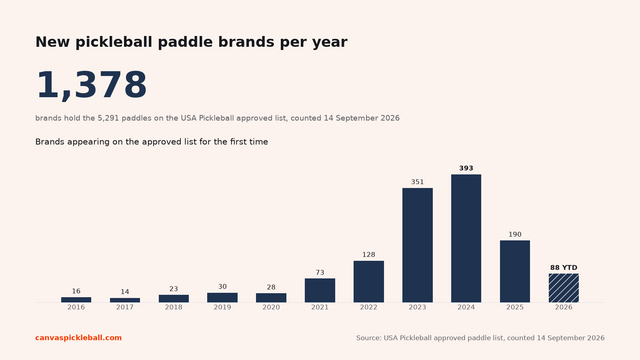 How Many Pickleball Paddle Brands Are There? We Counted Them
-
 IPMA Pickleball Paddle Certification: Fees, Process and Who It Fits
-
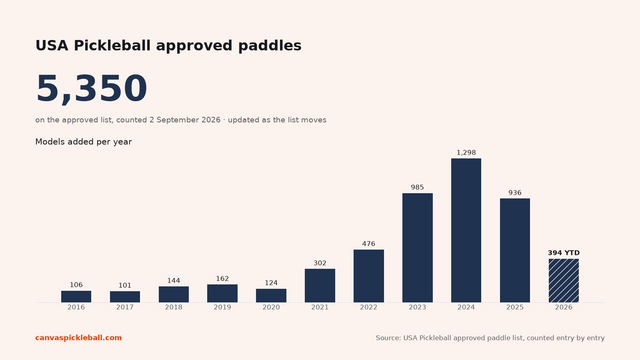 How Many USA Pickleball Approved Paddles Are There? The Count
