
OEM vs ODM vs Private Label Pickleball Gear: What You Actually Own
Factories use OEM, ODM and private label interchangeably, and they are not the same thing. Who owns the mold, whether a competitor can sell your exact paddle, and how much you commit before selling a unit.

We build custom gear across all three models, so this guide is the map we wish buyers arrived with. Definitions come from sourcing professionals, figures from factories' own published pages, labelled as such, and the cautionary tales from the sport's public record.
The short version. White label / private label: the factory's finished paddle with your logo, fastest and cheapest, and a dozen brands may sell the same paddle. ODM: the factory's design and mold, customised graphics and spec; you own the brand, the factory owns the design. OEM: your design, a new mold, real tooling money, and ownership that is only real if your contract says so. The ladder runs speed and cheapness at one end, defensibility at the other.
The three models, side by side
| White / private label | ODM | OEM | |
|---|---|---|---|
| Who designs it | Factory, finished product | Factory, you customise | You |
| Who owns mold and design | Factory | Factory | You, if negotiated in writing |
| Tooling cost | $0 | $0 to ~$1,500 | ~$500 to $10,000 by mold type |
| Typical paddle MOQ | Lowest, sometimes 50 to 100 | 100 to 300 | 300 to 2,000 |
| Published lead times | 2 to 4 weeks | 6 to 8 weeks | 12 to 16 weeks, samples 60 to 90 days |
| Can competitors sell your paddle? | Yes, routinely | Yes, the base design | Not if your agreement holds |
What the words actually mean
The twins problem, on the record
Who owns what: the part that bites later
Anjoran's warnings on ODM arrangements are blunt and specific. On tooling: "By default, Chinese suppliers will consider they own all the tooling, all the designs, etc." On switching: "Changing the supplier is difficult, since they own the design." And on incentives once you succeed: "If your sales are high, the supplier will be very tempted to compete with you." His prescription is contractual: an enforceable agreement covering non-disclosure, non-use and non-circumvention, negotiated before development starts, because the factory doing free engineering work is exactly the factory planning to reuse it.
Choosing: an honest decision guide
Go OEM when differentiation is the business. A new mold costs real money and months, but it is the only tier where "nobody else can sell this paddle" can be made true. Make it true in writing: mold ownership, design rights and non-circumvention are negotiated before the deposit, not after the first reorder.
Whichever tier, ask the ownership questions first. Who owns the mold if I paid for it? Can this design be sold to anyone else, and has it been? Whose patent exposure am I inheriting? The sourcing checklist covers the rest of the vetting.
Where Canvas sits in this
Common questions
What is the difference between OEM and ODM for pickleball paddles?
OEM means the factory builds your design and, with the right contract, you own it. ODM means you customise the factory's existing design and mold; the factory keeps the design rights and can sell the base paddle to others. Most "custom" paddle programs are ODM.
What does a custom paddle mold cost?
Factory-published figures run about $500 to $1,500 for a simple bonded aluminum mold and $2,000 to $5,000 for a precision thermoforming mold, with some factories quoting up to $10,000. On an existing mold the tooling cost is zero, which is why minimums and prices are lower.
Can another brand sell the same paddle as mine?
Under white label or ODM, yes. The documented Volair and Ronbus case showed two brands selling what reviewer Chris Olson found to be near-identical paddles at $160 and $120, and he noted factories offering one brand's model to another "is not uncommon." Only an OEM arrangement with negotiated design ownership prevents it.
Should a new brand pay for a custom mold?
Usually not first. Sourcing guidance converges on testing demand through existing molds at low minimums, then investing in tooling once volume is validated, roughly the 2,000-unit mark by published rules of thumb. A mold is the price of defensibility, and it is worth paying only once there is something to defend.
Sources
- Sofeast, ODM definition and design rights
- QualityInspection.org, OEM, ODM and CM, and default tooling ownership
- Renaud Anjoran, the danger of developing with an ODM factory
- Pickleball Studio, the Volair and Ronbus comparison
- The Kitchen, on catalogue paddles across brands
- NexaPaddle, white label, private label and OEM tiers
- NEX Pickleball, OEM vs ODM published figures
- Top Carbon Sports, published mold costs
- Global Carbon Sports, on starting with an existing mold
- The Dink, JOOLA's ITC patent complaint against eleven brands
Factory figures are the factories' own published marketing numbers, consistent across three independent sources but not audited. Checked August 2026; the Updated date above reflects the most recent re-check. Corrections welcome and made promptly.
Keep reading
-
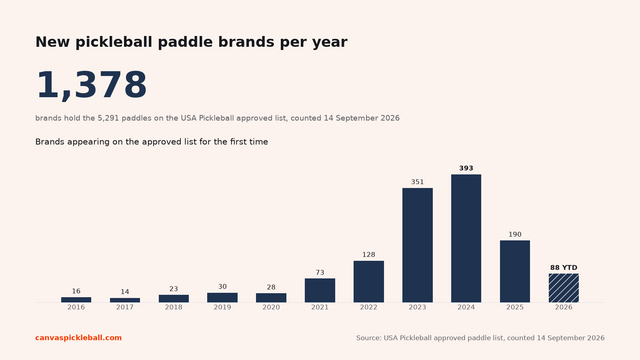 How Many Pickleball Paddle Brands Are There? We Counted Them
-
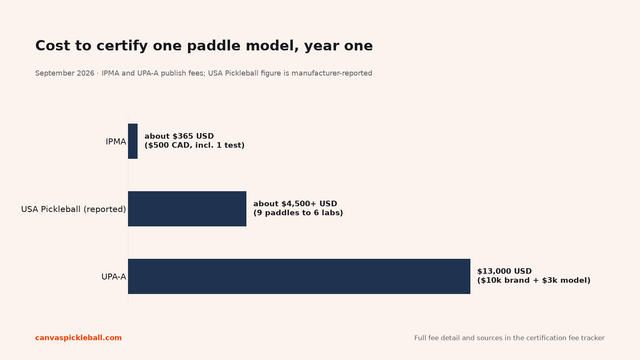 IPMA Pickleball Paddle Certification: Fees, Process and Who It Fits
-
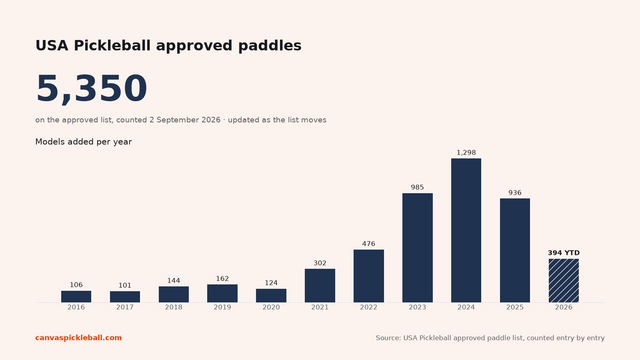 How Many USA Pickleball Approved Paddles Are There? The Count
