
MOQ Reality: The Real Minimums for Custom Pickleball Gear
Every supplier quotes a different minimum and the number keeps moving. The real minimum order quantities for custom paddles, covers, grips, balls and bags, from verified listings, plus which ones bend.

Every first conversation about custom gear reaches the same question within minutes: how many do I have to buy? And every supplier seems to answer it differently. One factory says a single paddle, another says 500. A quoted minimum of 100 becomes 300 once you pick a colour. None of it feels like a system.
It is a system, though. We manufacture custom gear across all of these categories, so we sit inside these minimums every week. This guide lays out the real numbers product by product, from listings and factory pages you can check yourself, then explains where minimums come from, which ones bend, and the mistake at the other end of the scale that does far more damage than any MOQ.

The three tiers of minimum
Minimums are not one market. They are three, and confusion between the tiers is where most first-time buyers get burned.
| Tier | Typical paddle minimum | What you trade |
|---|---|---|
| Factory direct, overseas | 100 with your logo, 300 to 500 fully custom | Lowest unit price. You carry freight, duties, quality risk and the relationship. |
| Domestic partner | 10 to 50 | Higher unit price. One contract, recourse in your own country, small runs possible. |
| Single unit / print on demand | 1 | Highest unit price. Perfect for sampling and testing, no economics for resale at scale. |
Paddles: the mold is the minimum
Covers and bags: sewn goods have sewn minimums
Overgrips: read the fine print, it is per colour
Printed overgrips are the category where the listing detail matters most. A representative listing runs 500 pieces per colour at $0.35 a grip, falling to $0.28 above 100,000. That "per colour" is the catch: a three-colour grip program is not a 500-unit commitment, it is 1,500. Fully custom grip material pushes the minimum far higher. If grips are on your list, they belong in the second wave of a launch, not the first.
Balls: 200, and the printing changed
Lead times, since the calendar is part of the minimum
| Product | Sample | Production run |
|---|---|---|
| Paddles | 3 to 15 days | 30 to 45 days; a new mold adds 15 to 30 |
| Covers | 5 to 7 days | 15 to 25 days after sample approval |
| Printed balls | 2 to 7 days | 5 to 12 days even at 10,000 units |
| Bags | 7 to 10 days | 30 to 45 days |
Is the minimum negotiable? Both answers are true
Sourcing professionals will tell you the number is softer than it looks. One China sourcing agency puts it flatly: "Suppliers publish a MOQ as a starting position, not a law." The same firm's explanation of where the number comes from is the honest one: a minimum is "not a random number but the point where tooling time, material buying, and line scheduling make a run worth the factory's while." Pay the setup cost separately, accept a stock colour, or piggyback a material the factory already buys, and the minimum often moves.
But there is a boundary, and it is worth hearing from the quality-control side. Renaud Anjoran, a quality engineer who has audited Chinese factories for two decades, notes that minimums often exist because the factory's own material supplier imposes one, and he offers a warning for the standard workaround: "Be careful promising that you will place big orders after your first trial order. Every factory has heard this story many times." Negotiate the setup economics, not with promises.
The mistake that outranks every MOQ
So run the tiers in order. Sample at one unit. Test at 10 to 50 through a domestic partner. Go factory-direct at 100 plus when the design has already sold. The tiers are not competitors, they are gears, and our guide to sourcing without getting burned covers how to vet whoever you shift into.
Where Canvas sits, plainly
Common questions
What is the minimum order for custom pickleball paddles?
Factory direct, typically 100 paddles for your logo on an existing mold and 300 to 500 for a fully custom shape. Domestic partners run 10 to 50, and single paddles can be ordered as samples at the top of the market.
Why do factories have minimum order quantities?
Setup costs are fixed: molds run $500 to $5,000 for paddles, print screens and plates cost money per design and per colour, and materials arrive at the factory with their own minimum buying units. The MOQ is the quantity where those fixed costs stop dominating the unit price.
Can you negotiate a factory MOQ?
Often, within limits. Paying setup charges separately, accepting stock colours or materials, and combining products into one order all move the number. Promising bigger future orders does not; factories have heard it before. Minimums imposed by the factory's own material suppliers rarely bend.
What is the minimum for custom printed pickleballs?
Around 200 balls at the factories we checked, with smaller runs possible at a higher unit price. Laser marking has largely replaced pad printing at the factory tier, which is part of why small runs have become cheaper.
How many paddles should a new brand order first?
Fewer than the factory minimum suggests. Sample at one unit, test the market at 10 to 50 through a domestic partner, and commit to a 100-plus factory run only once the design has demonstrably sold. Unsold inventory is the most common way new gear brands lose their cash.
Sources
- ApexonSport, 100-unit standard MOQ and sample lead times
- TopCarbonSports, published mold, setup and sample costs
- TopCarbonSports, custom-shape minimums and lead times
- A Dongguan paddle factory's published unit costs and 100-piece MOQ
- The same factory's 200-ball minimum and laser marking
- iAcesport, 200-ball minimum and production lead times
- Made-in-China, overgrip listing at 500 pieces per colour
- Caesar Sport, 100-piece cover minimum
- Made-in-China, bag listing at 500 pieces with $50 samples
- CustomLogoIt, promotional-tier pad-printed ball pricing
- Rivta, why sewn goods carry minimums
- Crestline, what a setup charge pays for
- MapleSourcing, negotiating MOQs with Chinese suppliers
- Renaud Anjoran, how to decrease a minimum order quantity
- JingSourcing, a paddle founder's inventory decisions
- Branded Pickleball, published 10-paddle minimum
- Diadem, published 50-paddle minimum
Figures verified against the listed pages in August 2026. Listing prices and minimums are the start of a negotiation, not a contract, so confirm directly before you budget. If you spot something out of date here, tell us and we will correct it.
Keep reading
-
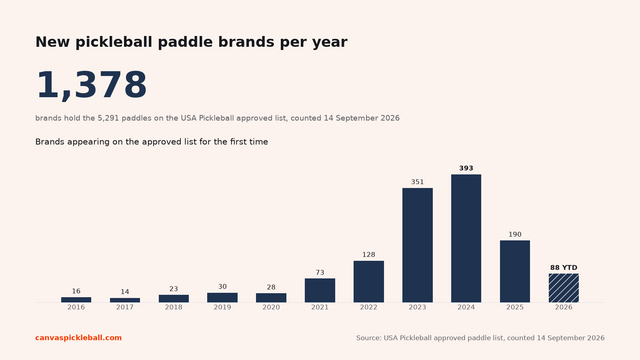 How Many Pickleball Paddle Brands Are There? We Counted Them
-
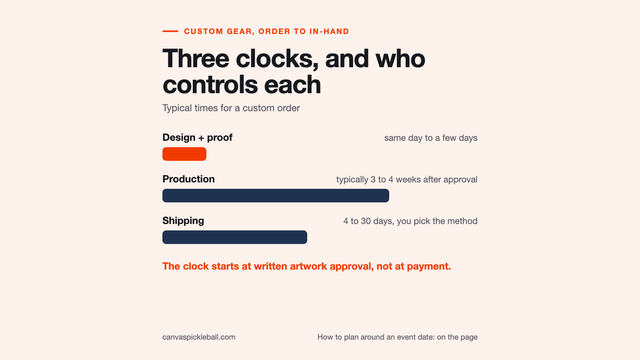 How Long Custom Pickleball Gear Actually Takes
-
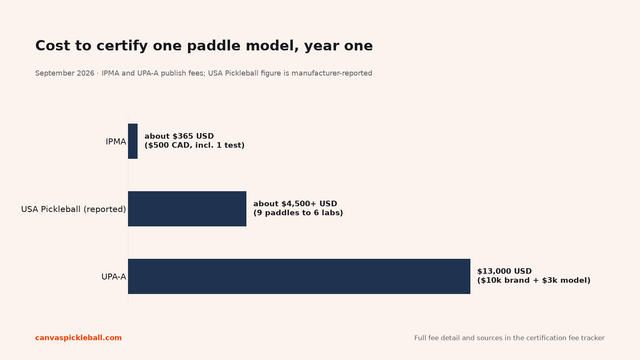 IPMA Pickleball Paddle Certification: Fees, Process and Who It Fits
