
How to Source Pickleball Products Without Getting Burned
What goes wrong between sample and production, a vetting checklist that works on any supplier, the minimums that decide your first run, and what a real quote contains.

The hard part of starting a gear brand is not the logo. It is the gap between the sample that turns up looking perfect and the pallet that turns up eight weeks later looking like something else. Most first-time brands lose their money in that gap, and almost all of it is avoidable with questions asked up front.

Where it actually goes wrong
The sample does not match the run
A supplier will hand-finish a sample to win your order. The production run comes off a different line, at speed, with less care. Ask whether your sample comes off the same process as production, and keep the approved sample sealed so you have something to hold the run against.
Colour drifts
Your brand blue on a screen, on a paddle face and on a neoprene cover are three different blues. Without a Pantone reference agreed in writing, you get whatever the printer's idea of blue is that week, and it will not match across products.
The minimum moves
A quoted minimum of 100 becomes 300 once you pick a colour, then 500 once you add a second product. Get minimums per product, in writing, before you fall in love with anything.
Nobody told you about landed cost
A quoted unit price is not what you pay. Freight, duties, customs brokerage and last-mile delivery can add a lot, and it is entirely normal for a first-time importer to discover this after the goods have shipped. Ask who is the importer of record and whether the quote is landed or at the factory gate.
The supplier goes quiet
The failure mode with no fix. You have paid a deposit, the messages slow down, and there is no entity in your country to hold to anything. This is the risk that should shape who you buy from more than price does.
How to vet any supplier, including us
Run this on every quote you get. It takes an afternoon and it is the cheapest insurance in the process.
- Can you find the business? A registered company, an address, a phone number that a human answers. If the only contact is a messaging app, that is your answer.
- Who is on the hook if it goes wrong? If there is no entity in your jurisdiction, you have goodwill rather than recourse.
- What exactly is included? Setup fees, artwork fees, plate or screen charges, proof costs, revisions. Ask for the number with everything in it.
- What is the minimum, per product? Not the headline minimum. The one for the specific colour and build you want.
- Will I approve a proof before production? The answer should be yes without hesitation, and it should cost nothing.
- What happens if the run is wrong? Ask before you order. The answer tells you more about a supplier than their sample does.
- Can they show work they have actually done? Not a catalogue of stock photos. Real production for real customers.
The minimums that decide what you launch with
Minimums vary far more by product than most people expect, and it is usually the deciding factor for a first run. Across our own line, paddles start at 10, paddle covers at 50, overgrips at 500 and printed balls at 100. That spread is fairly typical of the category.
The practical read: paddles are the cheapest way to test whether anyone wants your brand, because the minimum is low enough that a failed launch costs you hundreds rather than thousands. Balls and grips have the best unit economics but only make sense once you have distribution, because you are committing to four figures of inventory before you know it sells.
What a real quote should contain
If you cannot see all of these, you do not have a quote yet, you have a number.
- Unit price at the quantity you actually want, not the best-case quantity
- Minimum for that specific product and colourway
- What the setup, artwork and proof costs are, if anything
- Lead time from approved proof, not from order
- Whether freight and duties are included, and who imports
- What happens if production does not match the approved proof
Buying through a domestic partner instead
The alternative to sourcing direct is buying from a company in your own country that manages production for you. You pay a little more per unit than a factory-direct price and you give up some control over the supply chain. What you get back is one contract, one point of contact, recourse that means something, and someone who has already made the mistakes on somebody else's order.
For a first line, that trade is usually worth it. For a brand doing serious volume with a full-time sourcing person, direct can make sense. Be honest with yourself about which one you are.
Where Canvas sits
We are the domestic partner version. Canvas is a US company in Fort Lauderdale, Florida, our team is stateside, and the number on our site is answered by a person. We manage a vetted manufacturing network across nine countries, including the USA, and match each product to the partner that builds it best, so you are not gambling on one anonymous factory.
Practically: you approve a free proof before anything is produced, there are no setup or design fees, we supply blank templates and dielines, we blind ship in your name, and where a product carries our mark as standard we take it off on request. Most suppliers in this category will not unbrand at all, so it is worth asking. If you want the detail, the private label page lays out minimums and pricing plainly.
And if you use the checklist above and go somewhere else, that is a fine outcome. A brand that asked the right questions is better for the sport than one that lost its first run to a supplier that stopped replying.
Before you budget for a production run, price the certification. We broke down what USA Pickleball, UPA-A and IPMA each charge in 2026, including the fees one of them does not publish.
Keep reading
-
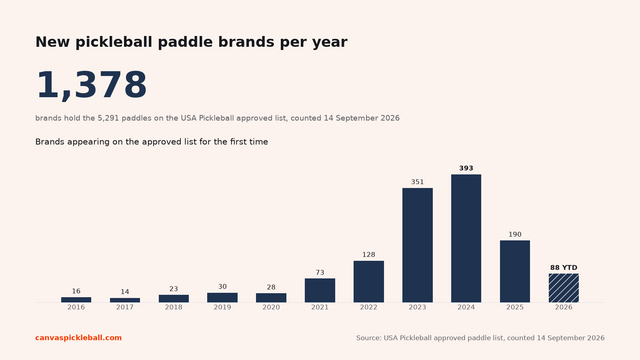 How Many Pickleball Paddle Brands Are There? We Counted Them
-
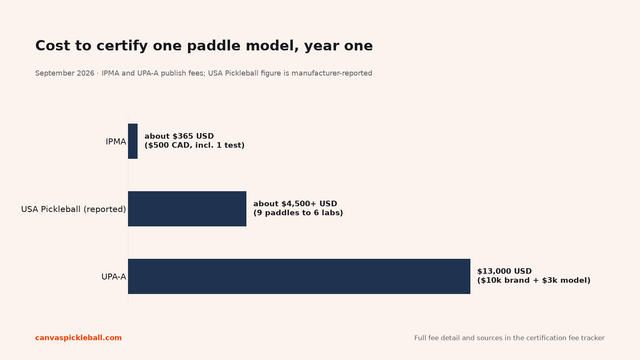 IPMA Pickleball Paddle Certification: Fees, Process and Who It Fits
-
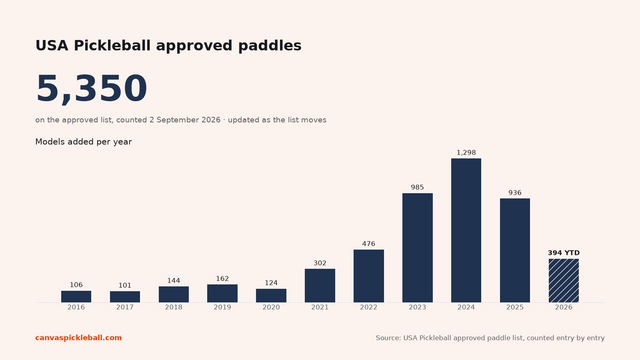 How Many USA Pickleball Approved Paddles Are There? The Count
